
Short answer: An endoscope can help you look for a visible obstruction in an accessible toilet route, but it cannot guarantee that the blockage is reachable or explain every hidden branch. The C30-M product page lists a 5 m semi-rigid cable, a single 8.5 mm camera head, IP67 camera-probe protection and LED illumination. It does not list a toilet-specific attachment, field of view, focus distance, display or recording specification. Work from a safe access point, move the head gently and record exactly what was visible. If the route is blocked, contaminated or unsafe to access, stop rather than forcing the camera.
Check the route before insertion
A blocked toilet may contain water, paper, cleaning chemicals or a solid object, so the access plan matters before the camera does. The C30-M has a listed 8.5 mm single camera head and 5 m semi-rigid cable. Those facts help you compare the head with an opening, but the seller does not specify the minimum passage, bend radius, cable force or a toilet-specific guide.
Choose an access point that does not require unsafe dismantling and keep the camera's stopping point clear in your notes. A five-metre cable is a physical length, not a promise that the head can travel five metres through every bend. Stop if the head catches or the cable begins to buckle.
| Question | Documented answer | Do not assume |
|---|---|---|
| How long is the cable? | 5 m semi-rigid cable | 5 m of usable straight-line visibility |
| How large is the head? | Single 8.5 mm camera head | Every opening above 8.5 mm is suitable |
| Is light listed? | LED illumination is listed | Brightness, beam or glare control |
| Is the probe protected? | IP67 camera-probe protection is listed | The full kit has the same rating |
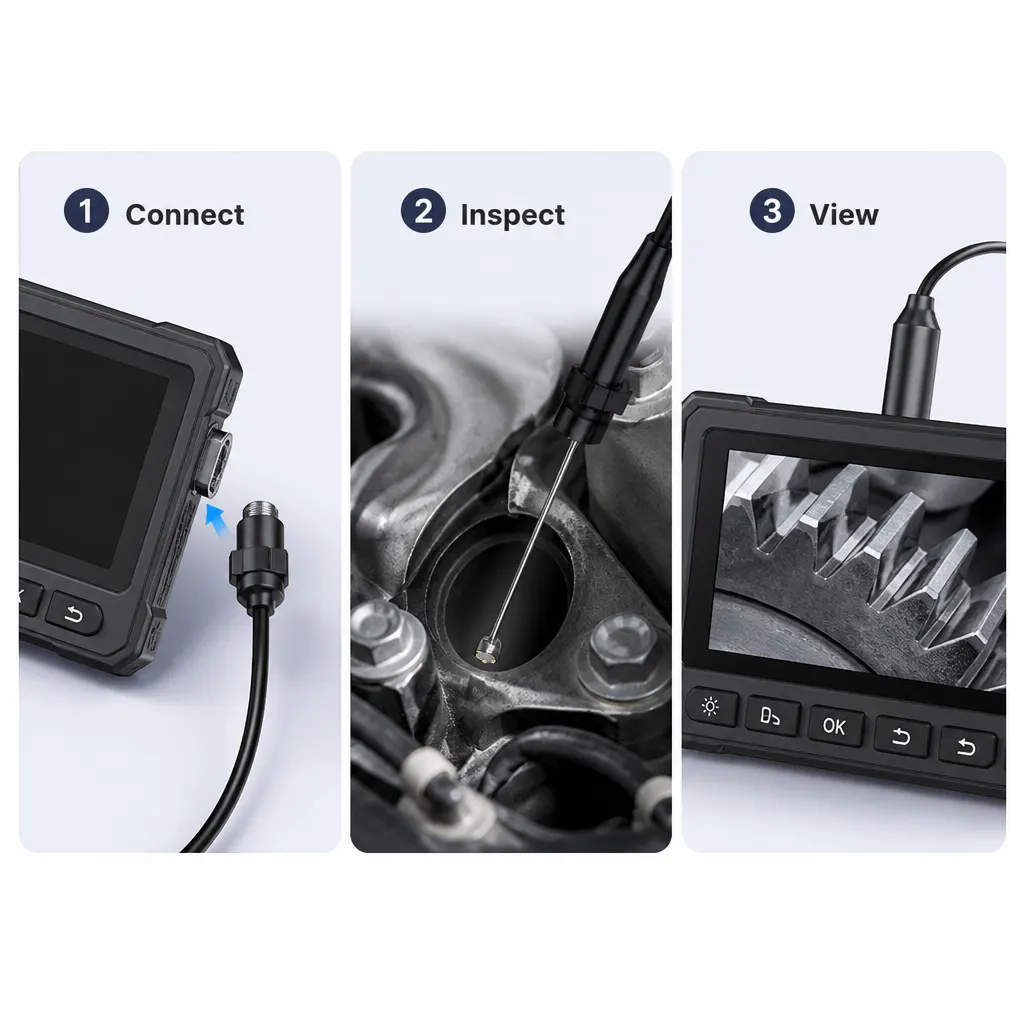
Control the sample view
Here the sample is the scene in front of the lens: water level, paper, limescale or an object. Do not confuse a clear lens view with a clear pipe. The listing does not provide field of view, focal distance, image resolution or a way to measure distance from the screen. LED illumination is listed, but the output and control are not.
Move slowly and note orientation, distance and the point where visibility ends. If the lens becomes coated, the result may describe the coating rather than the blockage. The page does not specify a cleaning or chemical protocol, so use only the product instructions and avoid presenting an unverified cleaning method as safe.
- Identify the access point and remove obvious loose material without pushing it farther into the route.
- Compare the 8.5 mm head with the opening, then insert gently while keeping the cable supported.
- Use the listed LED light, pause at bends and record what the camera can and cannot show.
- Stop when resistance, contamination or unsafe access appears, and seek a plumber when the blockage is not clearly within the visible section.
Treat IP67 as a limited listing
The product page says IP67 camera-probe protection. Keep that wording precise. It identifies the camera probe in the listing, not a complete claim about the handle, display, cable connector or the effect of toilet chemicals. The page also does not specify pressure, temperature, immersion duration or chemical compatibility.
Do not use the camera to justify putting electrical equipment into a situation the instructions do not cover. The purpose here is visual observation at an accessible route. If the job involves contaminated water, hidden pipework, structural damage or a confined space, the camera does not remove the need for a suitable professional method.
Set the observation boundary
A visible obstruction is an observation at a particular position and angle. It is not proof that no second obstruction exists, that a side branch is clear or that the pipe has no crack behind the current view. Because field of view and focus distance are not specified, write down the viewing boundary rather than claiming a complete inspection.
Before ordering, confirm whether your intended workflow needs a screen, still images, video, a retrieval accessory or an exact minimum passage size. Manufacturer does not specify those details on the current product page. The C30-M is a better match when the documented cable and head dimensions are enough for a cautious look, not when the job depends on undocumented diagnosis features.
Related guides and product details
Use the C30-M as a cautious visual aid for an accessible toilet route, and stop the inspection when the camera cannot safely or clearly show the cause. Read Endoscope Camera 5m UK: Check the Head, Cable and View for related guidance. Read Drain Inspection Camera DIY: Check Access Before You Buy for related guidance. Review the documented specification on the C30-M 5 m single-head endoscope camera product page before ordering.
Sources and safety context
- Supports the 5 m cable, 8.5 mm head, IP67 camera-probe wording and LED illumination. C30-M 5 m single-head endoscope camera product page.