
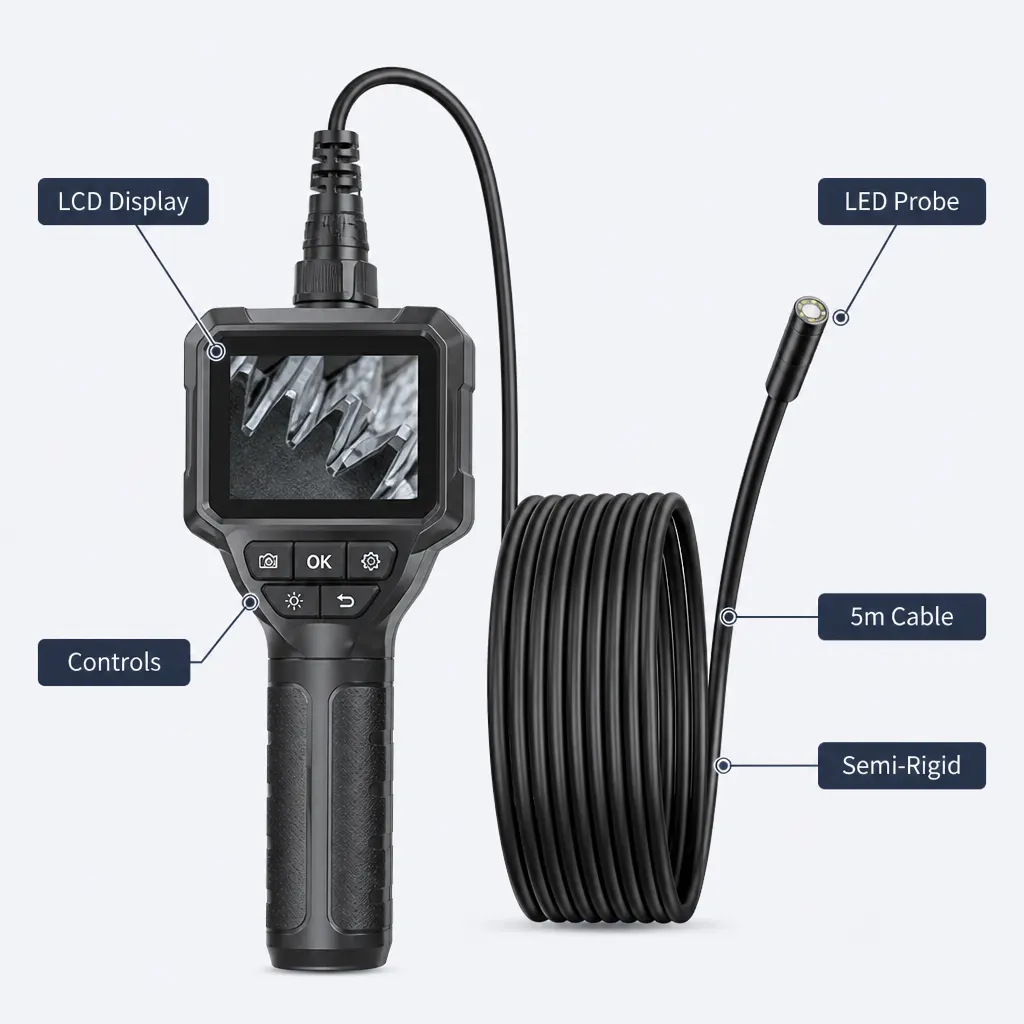
Short answer: A 5 m endoscope camera sounds versatile, but cable length is only one part of the buying decision. The C30-M listing specifies a 5 m semi-rigid cable, one 8.5 mm camera head, IP67 camera-probe protection and LED illumination. It does not specify the screen arrangement, field of view, focal distance, image resolution, recording, bend radius or minimum passage. Compare those unknowns with the inspection you need to perform. A long cable can reach farther only when the route, head size, bends, light and viewing angle all permit it. Keep the purchase decision tied to published facts.
Compare length with access
The C30-M product page gives a 5 m semi-rigid cable. That is the published cable length and a useful first comparison against the route you want to inspect. It does not tell you how much cable will be consumed by bends, how sharply it can turn, how firmly it can be pushed or whether the handle and connector add to the practical footprint.
The single 8.5 mm camera head is the published head dimension. Check the opening and the path, then ask whether the camera needs to pass a trap, joint, conduit bend or narrow channel. Manufacturer does not specify a minimum passage diameter or bend radius. Leave those as unknowns unless the documentation supplies them.
| Selection point | C30-M listing | Confirmation still needed |
|---|---|---|
| Cable | 5 m semi-rigid | Usable reach through the intended bends |
| Camera head | Single 8.5 mm | Minimum passage and bend radius |
| Lighting | LED illumination listed | Output, beam and control |
| Protection | IP67 camera-probe protection listed | Whole-system and chemical limits |
Check the light and scene
LED illumination is listed, which supports the basic idea of lighting a dark inspection area. The page does not specify brightness, beam angle, colour temperature or dimming. Reflective metal, standing water, dust and a lens close to a surface can all change what appears on the image. Treat the light as an aid, not as a guarantee of clear coverage.
The listing also does not state field of view, focal distance, resolution, display type or recording. Those omissions matter if you need to identify a small crack, document evidence or inspect a wide cavity. Ask for the exact specification before buying when an optical detail is part of the job rather than a nice-to-have.
- Measure the entry and compare it with the listed 8.5 mm head without assuming a matching opening is automatically safe.
- Map the likely route and note bends, branches and the point where the five-metre cable would stop.
- Confirm whether the unlisted display, focus and recording details matter to the decision before ordering.
- Use the LED light and move slowly during inspection, recording the visible boundary rather than claiming full route coverage.
Keep the protection claim narrow
IP67 camera-probe protection is listed for the camera probe. Use that phrase exactly when comparing products. The seller page does not extend the statement to the display, handle, connector or cable joint, and it does not specify resistance to chemicals, hot liquid, pressure or repeated immersion. A probe protection label is not a substitute for an operating manual.
Set a cleaning and storage routine that follows the supplied instructions. If the work involves a contaminated or aggressive liquid, confirm compatibility first. Where the manufacturer does not specify the medium, temperature or duration, leave the condition unresolved and do not turn the listing into a general waterproof-performance claim.
Buy for the actual view
The C30-M is a reasonable shortlist item when a five-metre semi-rigid cable and one 8.5 mm head match the physical access route. It is not enough evidence for a purchase that depends on a particular camera angle, close-focus distance, saved video, monitor size or measured image detail. Those are separate specifications and remain unlisted.
Before ordering, write a one-line acceptance test: the opening, the route, the light conditions, the required view and the evidence you need to save. Compare that list with the published facts. If any required item is missing, ask for documentation or choose a product with the needed specification rather than filling the gap with a guess.
Related guides and product details
The C30-M makes sense when the physical route is the main constraint and the documented cable and head size fit; optical and recording requirements need separate confirmation. Read Drain Inspection Camera DIY: Check Access Before You Buy for related guidance. Read Endoscope for a Blocked Toilet UK: What It Can Actually Show for related guidance. Review the documented specification on the C30-M 5 m single-head endoscope camera product page before ordering.
Sources and safety context
- Supports the published cable, camera-head, probe-protection and LED facts. C30-M 5 m single-head endoscope camera product page.